Lulu Ledger vs. Realtyzam
Realtyzam is streamlined real estate bookkeeping. Lulu Ledger adds a broader pipeline, commission calculations, mileage, goals, and performance insights around the same deals.

Who should choose each product?
Choose Lulu Ledger if…
Choose Realtyzam if…
Three questions reveal the difference.
The products share many core capabilities. The distinction becomes clearer when you look beyond basic bookkeeping.
Does it connect the deal to the money?
Lulu Ledger
Yes. Lulu Ledger begins with the real estate deal, including its pipeline stage, contract price, commission structure, splits, and fees. Income and related expenses can then be connected to the deal that produced them.
Realtyzam
Yes. Realtyzam tracks sales activity, commissions, brokerage splits, broker fees, expenses, and profitability by sale. It can remember an agent’s commission percentages and use them when calculating the brokerage split.
Does it help agents understand and plan their business?
Lulu Ledger
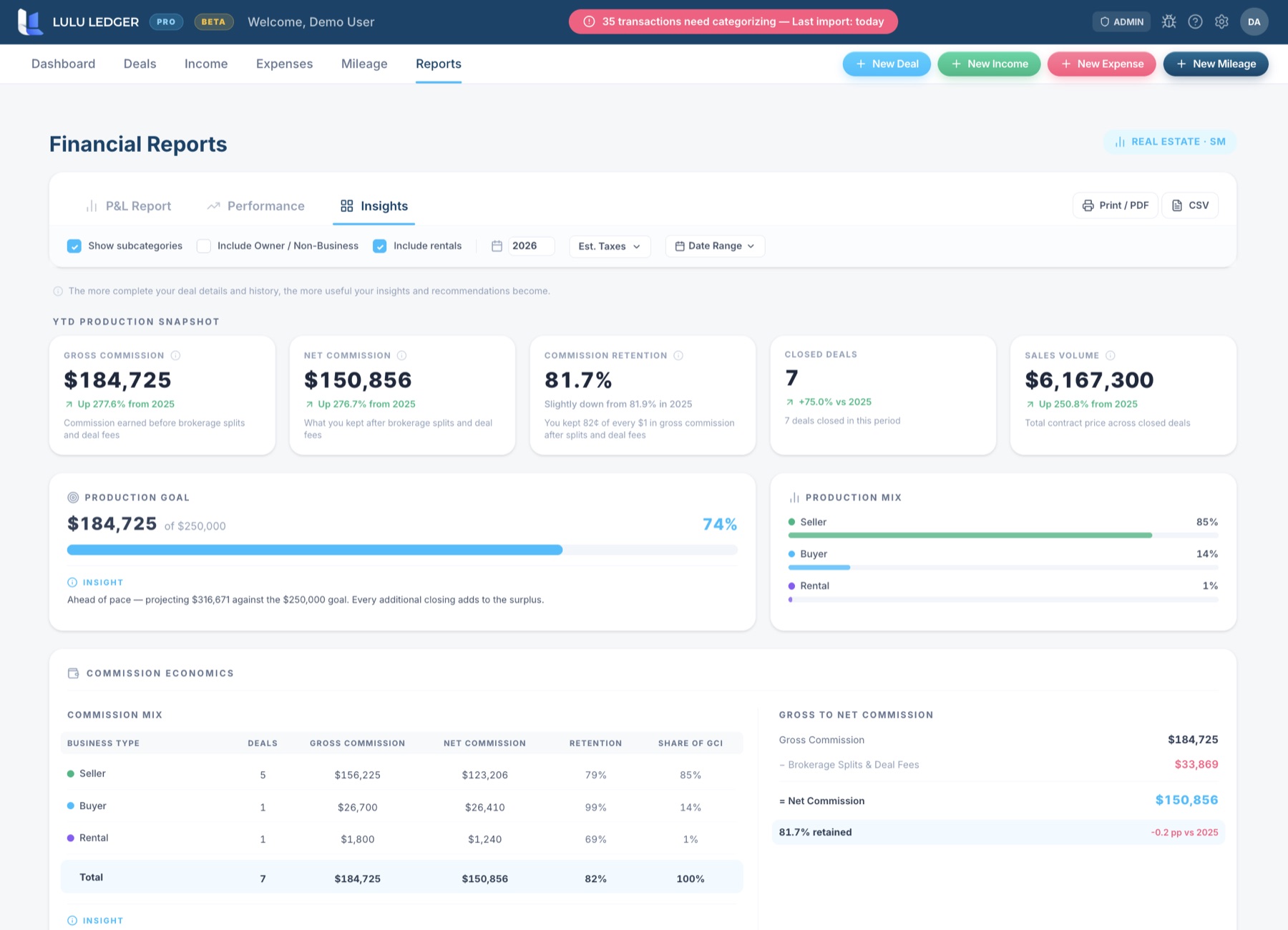
Lulu Ledger combines deal and bookkeeping records with estimated tax planning, production-goal tracking, year-over-year performance, and insights across deals, income, expenses, and profitability.
Realtyzam
Realtyzam provides useful historical sales and activity statistics, including average commissions, buyer and seller conversion rates, broker fees, lead-source performance, and profit and expenses by sale. Estimated tax planning and production-goal coaching are not documented features.
How much setup and upkeep does it require?
Lulu Ledger
Lulu Ledger is designed for a straightforward start. Agents can connect accounts, add or import deals, and begin reviewing transactions without journal entries or spreadsheet formulas.
Realtyzam
Realtyzam is also designed for simplicity. It imports bank and credit-card transactions, applies user-created categorization rules, stores receipts, and generates tax reports without requiring full double-entry accounting.
Lulu Ledger vs. Realtyzam, row by row.
These products overlap substantially. The most meaningful differences are in planning tools, insights, mileage handling, price, trial length, and platform experience.
| Capability | Lulu Ledger | Realtyzam |
|---|---|---|
| Built specifically for real estate agents | ✓ Built for solo agents and small teams | ✓ Built exclusively for real estate agents |
| Deal and commission tracking, pipeline to close | ✓ Built-in deal pipeline with listing, buyer, rental, and referral income | ✓ Sales-activity tracking for clients, leads, sales, and commissions |
| Splits, fees, and per-deal profit | ✓ Calculates commission breakdowns, splits, fees, and results for each deal | ✓ Remembers commission percentages, calculates brokerage splits, tracks broker fees, and reports profit and expenses by sale |
| Bank and card sync | ✓ Read-only connection through Plaid | ✓ Automatic bank and credit-card feeds, with file upload also available |
| Receipt capture and matching | ✓ Capture receipts and review suggested transaction matches | ✓ Uploads, scans, and connects receipts to expenses |
| Mileage tracking | ✓ Dedicated trip records with the applicable IRS mileage rate based on the trip date | ✓ Mileage logging is available. Automatic handling of changing IRS mileage rates is not documented. |
| CPA-ready reports and exports | ✓ Profit and loss reports with PDF and CSV exports | ✓ Printable quarterly and year-end tax reports. Realtyzam also states that user data can be provided in Excel format. |
| Estimated tax planning | ✓ Estimated using the agent’s configured tax rates and current results | Not documented as a current product feature |
| Production goals and performance insights | ✓ Production-goal tracking, year-over-year performance, and insights across deals, income, expenses, and profitability | ✓ Sales statistics include conversion rates, average commissions, broker fees, lead-source performance, and per-sale results. Production-goal planning is not documented. |
| Full double-entry or accrual accounting | ✕ Designed for simpler cash-basis recordkeeping and planning | ✕ Designed for simpler real estate bookkeeping rather than full double-entry or accrual accounting |
| Payroll, invoicing, and inventory | ✕ Outside Lulu Ledger’s scope | ✕ Does not provide payroll, invoicing, or inventory management |
| Pricing | $14.99/month or $149/year with Founder pricing | $14/month or $11.58/month billed annually |
| Free trial | 14 days, full product. Payment method required, $0 charged today. | 30 days, no credit card required. Realtyzam states that eligible accounts may remain free after 30 days until two properties are sold or $3,000 of income and expenses is recorded. |
A ✕ in Lulu Ledger’s column is deliberate: it marks things Lulu Ledger intentionally doesn’t do. No tool should win every row of its own comparison.
Enter the deal once. Understand the entire business.
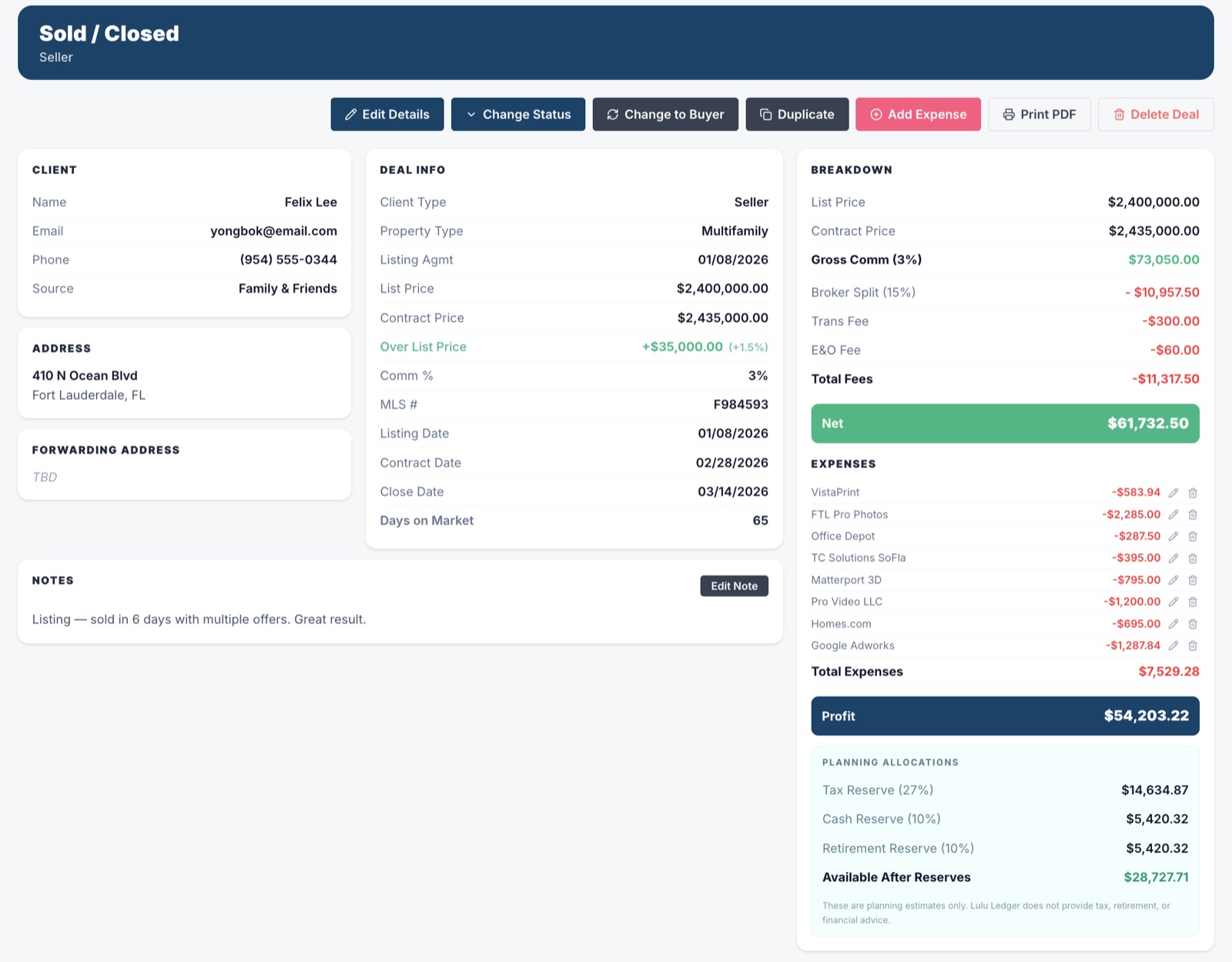
Lulu Ledger’s deal section is more than a transaction list. It keeps the client, contact information, notes, property details, status, dates, commission terms, income, and related costs connected in one workspace.
As the deal progresses, that information updates commission calculations, pipeline reporting, production, estimated taxes, goals, and performance insights. Instead of rebuilding the same story across separate tools, agents can see what is closing, what they may earn, what they may keep, and how the business is performing.
 DEALS · DEAL WORKSPACE · SOLD
 REPORTS · INSIGHTS · YEAR TO DATE
Lulu Ledger vs. Realtyzam: FAQ
Can I switch to Lulu Ledger from Realtyzam?
Yes. Lulu Ledger supports CSV imports for closed deals, income, and expenses. Export or request the Realtyzam records you want to keep, format them using Lulu Ledger’s import templates, and review the imported information before relying on reports. Because the products organize some information differently, sales-activity, contact, reminder, or document data may not map directly to Lulu Ledger.
Does Lulu Ledger replace Realtyzam?
Lulu Ledger can replace Realtyzam for agents whose primary needs are deal tracking, commission calculations, income, expenses, receipts, mileage, reports, and business planning. Agents who rely heavily on Realtyzam’s client records, follow-up reminders, document storage, or native mobile apps should compare those workflow differences before switching.
How do the prices compare?
Lulu Ledger offers Founder pricing of $14.99 per month or $149 per year. Realtyzam lists pricing of $14 per month or $11.58 per month when billed annually, making Realtyzam the lower-cost option. Pricing may change, so confirm current information before subscribing.
Can I try both products before deciding?
Yes. Lulu Ledger provides a 14-day free trial that requires a payment method and charges $0 today. Realtyzam offers a 30-day trial with no credit card required and states that eligible accounts may remain free until two properties are sold or $3,000 of income and expenses is recorded.
Research note: This comparison is based on publicly available product and pricing information. Features, pricing, and offers may change. Confirm current details directly with Realtyzam.
The fastest comparison is trying it.
Full product, free for 14 days. Use your own deals, your own numbers, and your own workflow.