Pending Commission Isn't Income Yet: How Real Estate Agents Should Track Their Pipeline
Pending commission isn't income yet. Learn how real estate agents can track pipeline separately from money received, then reconcile it to a 1099 and P&L.
Quick answer
A pending deal is a forecast, not income. If your business uses the cash method, commission generally counts as income when you actually or constructively receive it, meaning it's credited to your account or made available to you without restriction. Keep your pipeline of expected commissions in one place and the money you've actually received in another, so a good-looking pipeline never inflates your books.
Why a pending deal and a deposit are two different numbers
Every agent has looked at a pipeline and thought, "I've basically earned this." It's an easy mistake. A pending deal has a price, a split, and a closing date on the calendar, so it feels like money.
But pending deals can fall through, change price, or close with a different commission than you first expected. Until the money reaches you, that number is an estimate. Treating it as income creates two problems:
- Your profit looks better than it is. Expenses are real and already paid, while the matching commission hasn't arrived.
- Your cash plan runs ahead of your bank balance. You commit to spending that depends on a check that hasn't been issued.
The fix isn't to ignore your pipeline. It's useful for planning. The fix is to track it separately from income so the two never blur together.
What the IRS says about timing
IRS Publication 538 explains that under the cash method, you include income when you actually or constructively receive it. Constructive receipt means an amount is credited to your account or made available to you without restriction. You don't need to have it in hand. The same publication notes that income isn't constructively received if your control over receiving it faces substantial restrictions or limitations. Publication 334, the IRS tax guide for small business, describes the same rule.
Two qualifications matter:
- The cash method is a choice, not a given. The Schedule C instructions say that, generally, you can use the cash method, an accrual method, or another method permitted by the Internal Revenue Code. Which one your return uses is a question for you and your tax professional, and the IRS says the method you use must clearly reflect your income and be used consistently.
- Year-end timing can turn on facts. If a closing happens late in December and your brokerage pays in January, the question is when the money was made available to you without restriction. That depends on your brokerage agreement and the facts, so bring those cases to your CPA instead of guessing.
Note what this rule does not say. It doesn't say income is recognized at contract, at "pending," or even automatically at closing. And it doesn't say anything about how much of your gross commission you keep. Your split, fees, and what your brokerage reports all vary by brokerage.
A simple way to keep pipeline and income apart
Use three buckets, and move a deal forward only when the facts change:
- Pipeline (expected). Deals that are prospects, active, or pending, with the commission you expect to net. This is a forecast.
- Closed, awaiting payment. The deal closed, but your commission hasn't reached you yet. Under the cash method, it isn't received income until it does.
- Received. Money that landed in your account, recorded as income.
Here's a hypothetical example, labeled as such: it isn't typical of any agent, and it isn't a tax calculation. Suppose you have three pending deals with expected net commissions of $8,200, $11,500, and $6,300. Your pipeline is $26,000 (8,200 + 11,500 + 6,300). One of those deals, the $11,500 one, closes and is paid in November. Your pipeline drops to $14,500, and your received income for the month is $11,500. The other two deals contributed nothing to income, even though they were "basically done" on paper.
That distinction is the whole point. The pipeline number tells you what might arrive. The income number tells you what did.
Reconcile to your 1099 and brokerage statements
When tax season arrives, your records meet the paperwork. The Schedule C instructions tell you to check any Forms 1099 you received for business income that must be reported as gross receipts. They also say that if the total reported in box 1 of Forms 1099-NEC is more than the total you're reporting on line 1, you should attach a statement explaining the difference.
You can't assume a 1099 will match your deposits or your gross commission. What a brokerage reports can vary by brokerage and by how your agreement is structured. So reconcile in this order:
- Your received-income records for the year.
- Your brokerage's commission statements.
- The 1099 you actually received.
If they differ, find out why before you file. Possible explanations include year-end timing, how your brokerage reports payments, and money you received outside the brokerage. Your CPA can tell you how to treat what you find.
How Lulu Ledger keeps the two separate
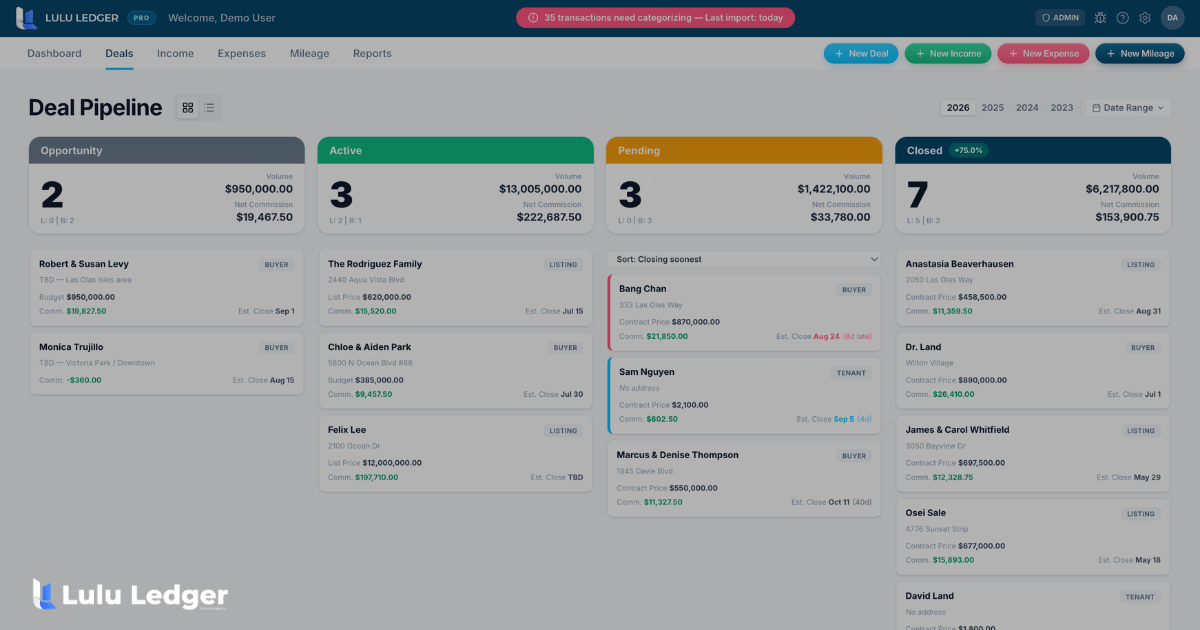
Lulu Ledger tracks listings, buyers, and rentals through four stages (prospect, active, pending, and closed), with volume and net commission visible at every one. That's your pipeline view.
Income works differently. As the Lulu Ledger Help Center puts it, "The deal record explains the transaction and its commission economics. The income transaction records the money actually received." Profit and Loss income comes from recorded income transactions, while deal production and commission reporting come from deal records. Those totals don't have to match, because they measure different things.
So you can watch your pipeline grow without your P&L treating expected commission as money in the bank. Lulu Ledger is a recordkeeping and planning tool. It doesn't decide what's taxable or when, and it doesn't file your taxes.
Keep your pipeline honest
If you're tired of a pipeline that looks like income, Lulu Ledger connects every deal to every dollar, with the deal record on one side and the money actually received on the other. You can try it free for 14 days. You won't be charged until the trial ends. Start Free for 14 Days or see the features and Help Center first.
Sources
- IRS, Publication 538, Accounting Periods and Methods (cash method; constructive receipt; consistent method)
- IRS, Publication 334, Tax Guide for Small Business (2025) (cash method income; constructive receipt)
- IRS, Instructions for Schedule C (Form 1040) (2025) (line F accounting method; line 1 gross receipts and Forms 1099-NEC)
- Intuit TurboTax Support, What is the cash method of accounting? (explanatory context only)
- Lulu Ledger, Features, Help Center, and Pricing
Is a pending commission taxable income?
If your business uses the cash method, income is generally included when you actually or constructively receive it, so a commission you haven't received or had made available to you is generally not yet included. Your accounting method and facts matter, so confirm with your tax professional.
Should I record a commission when the deal closes or when I'm paid?
Track both, but in different places. Record the closing in your deal record, and record the income when the money is received. That keeps your production numbers and your income numbers each accurate.
Why doesn't my P&L match my closed-deal commissions?
They measure different things. In Lulu Ledger, P&L income comes from recorded income transactions and deal production comes from deal records, so the totals don't have to match.
What if my 1099-NEC is higher than my deposits?
The Schedule C instructions say to attach a statement explaining the difference if box 1 amounts on your 1099-NEC forms exceed what you report on line 1. Reconcile it against your brokerage statements first and ask your CPA how to handle it.
Can I use my pipeline to plan cash flow?
Yes, as an estimate. Pending deals can change or fall through, so treat the pipeline as a forecast, not as money you've received.
Does Lulu Ledger tell me what counts as income for tax purposes?
No. It's a recordkeeping and planning tool. It doesn't provide tax, legal, accounting, financial, or investment advice, so review your situation with a qualified professional.



Reading about it is good. Seeing yours is better.
Full product, free for 14 days. Set up in about 10 minutes.