How Much Should Real Estate Agents Set Aside for Taxes From Every Commission Check?
Real estate commission checks don't have taxes withheld like a paycheck does. Here's how to figure out a smart reserve percentage and avoid a surprise tax bill.

Quick answer
There's no single percentage that works for every agent, because your reserve should be based on your net business profit, not your gross commission or the amount that lands in your bank account. As a starting point, self-employment tax alone is a flat 15.3% of your net self-employment earnings, and federal (and often state) income tax stacks on top of that based on your bracket. That means your floor is knowable but your total isn't — the only way to land on your actual number is to run it against your own income, deductions, and filing status, ideally with a CPA. A reserve is a cash-management habit; it doesn't replace calculating your real quarterly estimated tax payment.
Why Commission Income Makes This Harder Than a Paycheck
When you worked for an hourly or salaried employer, taxes came out before you ever saw the money. As a real estate agent, you're almost always paid as an independent contractor, which means your brokerage doesn't withhold anything from your commission check. Whatever hits your account is the full amount you're responsible for tracking, not a number that's already been through payroll.
That shift catches a lot of agents off guard in their first year or two. The commission check feels like income you can spend, but part of it isn't really yours yet — it's money you owe the IRS (and possibly your state) that just hasn't been paid out yet. Setting aside a reserve from every check, rather than trying to come up with a lump sum at tax time, is the practical fix.
What the Reserve Should Actually Be Based On
Before you pick a percentage, it helps to be clear about which number you're taking a percentage of. A single commission check typically passes through several layers before it becomes your taxable business profit:
- Gross commission income (GCI) — the total commission generated on the deal. GCI is a production metric, not a number you report to the IRS as your income.
- Broker split, company dollar, transaction fees, E&O, or desk fees — whatever your brokerage's agreement takes off the top before you're paid. How this is structured and reported varies by brokerage, so check your own commission statements and 1099-NEC rather than assuming your split works the same way another agent's does.
- Net commission actually deposited — what lands in your account after the split and brokerage fees.
- Net business profit — your net commission minus your deductible business expenses (marketing, mileage, MLS and association dues, E&O insurance, software, and so on).
Your tax reserve should be a percentage of that last number, net business profit, not of GCI and not of the raw deposit. Reserving a flat percentage of GCI will consistently overestimate what you owe, because it ignores everything your brokerage already took out and every legitimate business expense you haven't spent yet from this deal. Reserving a percentage of the deposit is closer, but still doesn't account for your deductible expenses.
The Tax Math Behind the Percentage
Two federal taxes apply to most self-employed agents' net profit, and they're calculated differently.
Self-employment tax. The IRS sets the self-employment tax rate at a flat 15.3% (12.4% for Social Security and 2.9% for Medicare) on your net self-employment earnings, once those net earnings reach $400 or more. You can deduct the employer-equivalent half of that tax when figuring your adjusted gross income, which softens the actual hit somewhat.
Federal income tax. On top of self-employment tax, your net profit also gets added to your other income and taxed at your regular federal income tax bracket, which depends on your filing status, total household income, and deductions. This is the part that varies the most from agent to agent — a solo agent in a lower bracket owes a very different combined rate than a top-producer married to a high earner.
State income tax. Depending on where you live and work, state income tax may or may not apply on top of the federal amount — a small number of states don't tax personal income at all, and the rest set their own rates and rules. Check your own state's current rules rather than assuming.
Stack those three together and it's easy to see why there's no universal "right" percentage — 15.3% is fixed, but the income tax layers on top of it are personal to your situation. Two agents with identical net profit can owe materially different amounts depending on filing status, household income, deductions, and which state they work in. That's why this is a number to calculate rather than copy: your CPA can pin it down for your actual return in minutes, and that figure will beat any rule of thumb you find online.
Quarterly Estimated Taxes Are the Real Deadline
Reserving money is only half the job. The IRS generally requires you to make estimated tax payments if you expect to owe at least $1,000 in tax for the year after subtracting withholding and credits — an easy threshold to cross when nothing is being withheld from your commission checks in the first place. Estimated payments are due in four installments across the year, roughly around April 15, June 15, September 15, and January 15 of the following year (the exact date shifts to the next business day if it falls on a weekend or holiday).
To avoid an underpayment penalty, the IRS's safe harbor rule says you generally need to pay the smaller of 90% of your current year's tax or 100% of your prior year's tax — that threshold rises to 110% of the prior year's tax if your prior-year adjusted gross income was above $150,000 ($75,000 if you're married filing separately). Missing this isn't just a paperwork issue; it triggers an actual penalty under the IRS's underpayment-of-estimated-tax rules.
The reserve you build from each commission check is what makes those four payments possible without scrambling. It doesn't have to sit in a specially labeled IRS account — it just needs to be money you haven't already spent when each due date arrives.
A Practical Way to Reserve at the Deal Level
Waiting until December to figure out what you owe means trying to reconstruct a year of deals, splits, and expenses from memory. It's easier to reserve as you go, deal by deal, right when the money comes in.
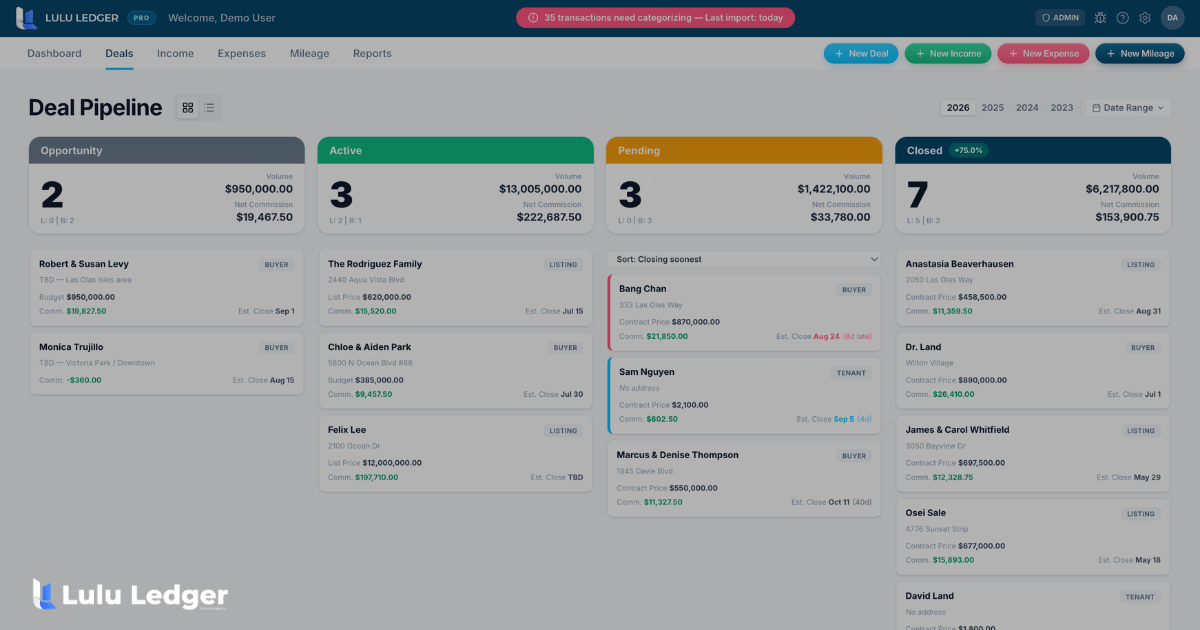
This is the specific problem Lulu Ledger's deal-level planning view is built around. When a deal closes in Lulu Ledger, the deal record calculates a default Tax Reserve (27%), Cash Reserve (10%), and Retirement Reserve (10%) from that deal's profit, and shows what's left as "Available After Reserves" — so you can see, deal by deal, what's actually yours to spend versus what needs to stay put. Those percentages are planning defaults, not IRS figures, and the product is explicit about that: they're estimates you can and should adjust once you and your CPA land on numbers that fit your actual bracket, state, and entity structure.
A reserve is a habit you build deal by deal. Waiting for one lump number in April is how agents end up surprised.
— Scott Morreau, Realtor & Founder, Lulu Ledger
Mistakes That Throw the Reserve Off
A few patterns come up often enough to call out directly:
- Reserving a percentage of GCI instead of net profit. This overstates your reserve on every deal where your brokerage takes a meaningful split.
- Treating your 1099-NEC total as your taxable profit. Your 1099 reflects what your brokerage paid you, not your profit after business expenses — reconcile it against your own books rather than assuming the two numbers mean the same thing.
- Skipping quarterly payments and planning to "true up" at filing. This is exactly the behavior the underpayment penalty exists to discourage.
- Ignoring state tax in a state that taxes income, because the federal self-employment tax number is the one that gets talked about most.
- Never revisiting the percentage. A reserve rate that fit your first year in the business may be wrong once your income, deductions, or entity structure changes.
Sources & References
- IRS: Estimated Taxes — Internal Revenue Service
- IRS Publication 505, Tax Withholding and Estimated Tax — Internal Revenue Service
- IRS: Self-Employment Tax (Social Security and Medicare Taxes) — Internal Revenue Service
- IRS Topic No. 306, Penalty for Underpayment of Estimated Tax — Internal Revenue Service
This article is for general education and isn't tax, legal, accounting, or financial advice. Talk with a qualified CPA about your specific numbers.
Ready to Stop Guessing at Tax Time?
Lulu Ledger connects every deal to every dollar, so your tax reserve is calculated the moment a deal closes instead of reconstructed in April. Try it free for 14 days — no charge today — with current founder pricing of $14.99/month or $149/year for the first 300 subscribers, backed by a 30-day money-back guarantee.
Lulu Ledger is a recordkeeping and planning tool. It does not provide tax, legal, accounting, financial, or investment advice. Review your specific situation with a qualified professional.
Is my tax reserve based on my gross commission or my net profit?
Your net profit — net commission after your brokerage's split and fees, minus your deductible business expenses. Basing a reserve on gross commission income (GCI) will consistently overestimate what you actually need to set aside.
What happens if I underpay my quarterly estimated taxes?
If your withholding and estimated payments fall short of the IRS's safe harbor thresholds (generally the smaller of 90% of the current year's tax or 100%/110% of the prior year's tax) and you owe $1,000 or more, the IRS can charge an underpayment penalty under its estimated tax rules, in addition to the tax itself.
Do I need to make estimated payments if I also have a W-2 job with withholding?
Possibly not, if your W-2 withholding alone is enough to satisfy the IRS's safe harbor for your total tax liability. This depends on how much your job withholds versus how much your commission income adds — a CPA can tell you whether increasing your W-2 withholding could replace separate quarterly payments.
Does the same reserve percentage work whether I'm a sole proprietor, an LLC, or taxed as an S-corp?
No. Entity structure changes how your income is taxed — for example, S-corp owners typically split compensation between W-2 wages (subject to payroll tax withholding) and distributions, which changes the mechanics significantly from a sole proprietor's self-employment tax. There's no universal percentage or income threshold that applies across entity types; this is worth a dedicated conversation with a CPA.
What if my commission income is extremely uneven month to month?
The IRS's standard estimated tax rules assume roughly even income across the year, but an annualized income installment method (via Form 2210) exists for taxpayers whose income is genuinely lopsided, and can reduce or eliminate a penalty tied to a slow first half of the year. A CPA can tell you whether it applies to your situation.
Where do I find the current estimated tax deadlines and safe harbor rules?
Directly from the IRS: Publication 505 (Tax Withholding and Estimated Tax) and Topic No. 306 (Penalty for Underpayment of Estimated Tax) on IRS.gov. Both are updated for the current tax year and are the most reliable source for the exact current numbers.
Keep reading


Reading about it is good. Seeing yours is better.
Full product, free for 14 days. Set up in about 10 minutes.